
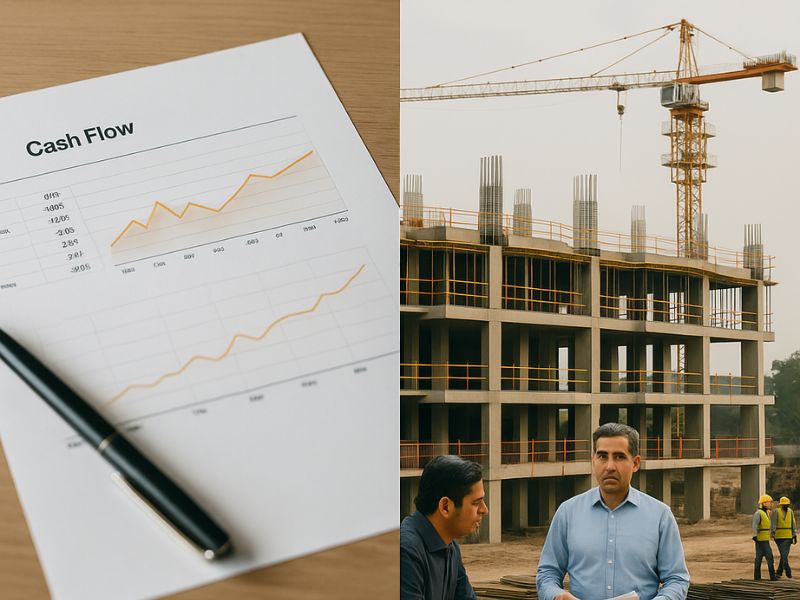
Every real estate developer knows this feeling:
Construction is ready to move,
contractor is pushing for payment,
labour wants their dues,
materials need to be ordered…
…but the disbursement hasn’t come.
And suddenly, a project that was supposed to run smoothly enters a cashflow choke.
Here’s the truth that many hesitate to admit:
Most cashflow problems don’t happen on site.
They happen in Excel.
A project becomes stressed when the cashflow on paper does not match the way construction actually moves on the ground.
In this article, I want to take you through how practical cashflow design can save crores, avoid delays, and protect your peace of mind.
If you’ve ever had to convince a lender, delay a vendor, or request a buffer from an investor, this will feel like your inner voice being spoken aloud.
Why Cashflow Issues Are So Common (Even for Experienced Developers)
Today’s developer is building in an environment where:
-
Lenders are cautious
-
Construction costs are rising
-
Buyers are selective
-
RERA timelines are strict
-
Approvals take unpredictable time
-
Sales velocity fluctuates
In such a scenario, a theoretical cashflow model — one that looks clean and linear — simply cannot support the reality of a dynamic project.
The problem is not that developers don’t plan.
The problem is that they plan with assumptions that don’t reflect ground behaviour.
What a Cashflow Should Really Achieve
A proper cashflow is not a nicely formatted sheet submitted to a bank.
A real project cashflow should:
-
Support construction speed
-
Protect working capital
-
Align with realistic sales absorption
-
Absorb shocks (cost escalations, slow sales, approval delays)
-
Reduce early repayment pressure
-
Match lender behaviour (banks vs NBFCs vs co-op banks)
-
Ensure smooth disbursement without friction
If your cashflow can do these seven things, your project will run like a well-planned engine.
Let’s break down how to design such a cashflow.
The 4 Major Components of a Cashflow That Actually Works on Site
1. Promoter Contribution Structured Correctly
This is where 80% of misalignment begins.
Common mistakes developers make:
-
Putting too much promoter contribution upfront
-
Putting too little in the first two stages
-
Relying heavily on unsecured loans in the middle
-
Not syncing promoter contribution with disbursement triggers
-
Creating contribution milestones that don’t match RERA withdrawals
A good structure ensures:
-
Adequate skin in the game early
-
Smooth fund flow in foundation & podium stages
-
Flexibility during superstructure
-
Zero cash crunch during finishing
Remember:
Promoter contribution is not “just money”.
It is timing + sequencing + purpose.
2. Bank Finance That Matches Project Rhythm
Different lenders behave differently.
Banks → low interest, slow disbursement, strict compliance
NBFCs → faster movement, higher interest, practical milestones
Co-op Banks → relationship-based, moderate speed
Private Financers → quick but expensive
Cashflow design must consider:
-
Which lender will support your project’s timeline?
-
How will their disbursement pattern match your slab cycle?
-
What kind of repayment schedule will support your sales strategy?
-
What buffer do you need in case collections slow down?
A mismatch here leads to:
-
Disbursement delays
-
Construction interruptions
-
Forced borrowing at high cost
Actionable takeaway:
Choose your lender based on behaviour, not brochure.
3. Sales Milestones That Don’t Choke the Project
Developers often accept sales milestones they “hope” to achieve.
But lenders only accept milestones backed by:
-
Market absorption
-
Competition pricing
-
Product category (affordable vs premium)
-
Buyer sentiment
-
Brand strength
Unrealistic milestones cause instant disbursement freeze.
For example:
-
“Sell 40% area before podium completion”
-
“Maintain ₹X minimum selling rate for all future bookings”
-
“Achieve ₹Y collections in the next quarter”
If these conditions slip even once, cashflow collapses.
A good consultant will:
-
Negotiate achievable milestones
-
Reduce aggressive sales conditions
-
Align collections with construction stages
-
Protect you from stress caused by slow markets
4. Repayment Structure Aligned With Actual Execution
This is one of the most ignored but crucial elements.
Wrong repayment structure means:
-
EMIs start too early
-
Heavy instalments during slab stage
-
Bullet repayment mismatched with OC timeline
-
Balloon repayment without sales backup
-
Unrealistic grace periods
Correct repayment design ensures:
-
Repayment starts only after real sales flow begins
-
No major outflow during labour-heavy construction phases
-
Lenders are confident of your payback capacity
-
Your project stays financially comfortable from start to finish
Good repayment planning saves crores in interest and prevents restructuring.
Common Cashflow Mistakes Developers Should Avoid
#Mistake 1 — Designing Cashflows Backwards
Cashflows are made to “fit” lender templates instead of fitting reality.
Fix:
Start with execution logic → then match to lender logic.
#Mistake 2 — Assuming Sales Will Pick Up Automatically
Sales depend on market conditions, not optimism.
Fix:
Keep conservative assumptions; build buffer.
#Mistake 3 — Heavy Reliance on Unsecured Loans
They give false confidence early but become a burden later.
Fix:
Use unsecured loans only as support, not as backbone.
#Mistake 4 — Not Accounting for Approval Delays
Environmental clearance, TDR, fire NOC, water NOC — all have unpredictable timelines.
Fix:
Always add buffer.
#Mistake 5 — Ignoring RERA Withdrawal Logic
RERA disbursement rules influence cashflow far more than developers realize.
Fix:
Align RERA + lender + construction milestones.
A Practical Framework for Designing a Real Cashflow (Not a Fancy One)
Step 1 — Map Construction Schedule to Fund Requirement
Use actual slab cycles, labour patterns, and material timelines.
Step 2 — Map Approvals to Timeline
Add buffer for each major approval.
Step 3 — Map Sales Absorption to Market Reality
Look at micro-market comparisons, not assumptions.
Step 4 — Create Two Cashflows
-
Conservative
-
Expected
Then choose a midpoint.
Step 5 — Design Milestones for RERA + Lender
Milestones must support, not suffocate.
Step 6 — Align Promoter Contribution
Structure contribution in stages so it supports early construction.
Step 7 — Plan Repayment After Sales Flow Begins
Not before.
Step 8 — Build a Shock Absorption Layer
Always have contingency for:
-
Cost escalation
-
Slow sales
-
Delayed disbursement
A 10–15% buffer protects the entire project.
Conclusion: Good Cashflow Is Not a Sheet. It Is a Safety Net
Developers often say:
“Project finance is tough.”
But the truth is — uncertain cashflows make it tough.
A good cashflow gives you:
✓ Smooth disbursement
✓ Zero surprises
✓ No pressure on site
✓ Stable negotiation power
✓ Lower interest burden
✓ Peace of mind
When cashflow planning is realistic, practical and aligned with all stakeholders — your entire project becomes predictable and stress-free.
Construction becomes execution, not crisis management.
Sales become strategy, not desperation.
Finance becomes support, not pressure.
That is the power of a cashflow that works on site, not just on paper.
If you’d like to review your project’s cashflow planning or want an external perspective before approaching lenders, you can reach out. Even a short discussion can save months of stress later.