
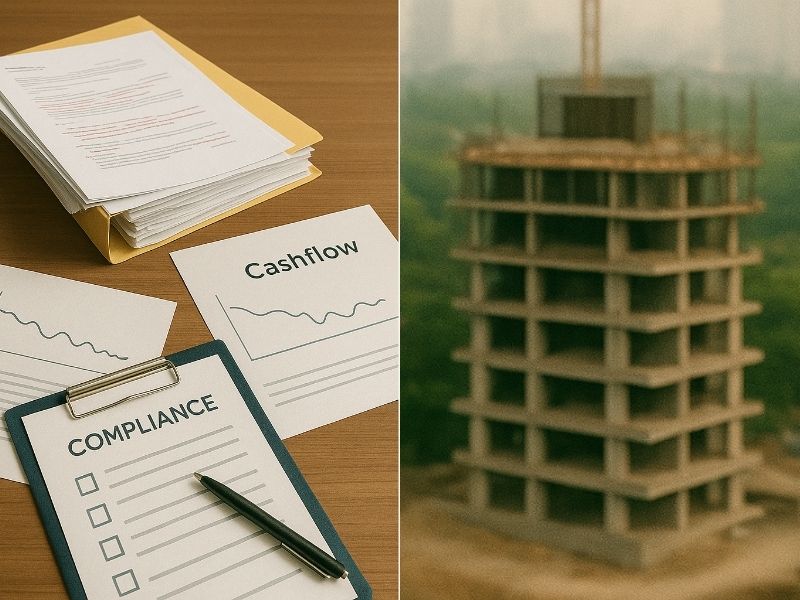
If you ask any developer why their project slowed down, they may point to labour issues, sand shortages, or weather interruptions.
But the truth is softer. And deeper.
Projects rarely get delayed on site.
They get delayed on the planning table—months before the first brick is laid.
Most developers feel this in their gut but don’t say it out loud.
And the cost of these early gaps?
Lost time. Lost cashflow. Lost peace of mind.
In this article, I want to break down why delays truly start much earlier, what creates those hidden bottlenecks, and how you can protect your project long before the file reaches a financer.
Let’s go into the reality that every builder faces, but very few openly talk about.
Why This Matters So Much Today?
The Indian real estate landscape has changed more in the last 7–8 years than in the previous two decades.
Lenders have become selective.
Approvals have multiplied.
RERA has made compliance non-negotiable.
Buyers expect faster delivery and transparent pricing.
In this environment, a project’s first 10–12 decisions — land structure, costing model, DA clauses, cashflow estimates, milestone design — decide how smooth or stressful the next 3–5 years will be.
Yet, many developers still approach project planning like:
“We will figure it out as we go.”
Unfortunately, lenders don’t think that way.
Markets don’t wait.
Cashflows don’t stretch.
RERA doesn’t forgive.
That’s why understanding early-stage planning is not optional anymore.
It’s the backbone of successful execution.
The Hidden Causes for Delays
Below are the major early-stage gaps that quietly snowball into big project delays.
If you fix these, you fix 70% of future stress.
1. Costing that “Looks Fine” on Excel But Fails on Site
Many projects start with costing estimates that are either too optimistic or too general.
-
Basement cost is underestimated
-
RCC rates don’t match the design
-
Labour availability is misjudged
-
Finishing escalations are ignored
-
MEP is estimated without technical inputs
These miscalculations create a simple problem:
Your cashflow assumptions stop matching real execution speed.
And once that mismatch begins, the delay cycle starts.
Actionable Fix:
Always build costing with real-time material benchmarks + execution methodology + contractor pattern + slab cycle assumptions.
2. Unrealistic Sales Milestones That Choke Disbursements
Lenders often include conditions like:
-
“Sell X sq.ft before next disbursement”
-
“Maintain minimum Y average rate”
-
“Collect Z amount before Stage ABC”
On paper, these look achievable.
On site, they often aren’t.
As soon as milestones clash with real market absorption, your disbursement stops, even though construction is ready to move ahead.
Actionable Fix:
Negotiate conservative milestones that match your target buyer segment and project phasing.
3. Legal & Documentation Gaps That Lenders Flag Too Late
A developer may feel land title is clean, but a lender sees:
-
A POA clause mismatch
-
Ambiguity in revenue-sharing vs area-sharing
-
Undisclosed tenancy
-
Improper NA order
-
Missing fire NOC chronology
-
TDR eligibility not clearly mentioned
-
Environmental clearance still pending
-
DA not covering lender requirements
Each of these creates weeks or months of delay after sanction.
By then, site work has already started, and cashflow pressure builds.
Actionable Fix:
Perform a legal and technical “pre-lender” audit before preparing a finance file.
4. RERA Milestones That Don’t Match Actual Construction Capability
Many developers unknowingly commit to RERA milestones that:
-
Don’t sync with contractor capacity
-
Don’t match disbursement-linked stages
-
Don’t reflect monsoon or labour seasonality
Once committed, RERA doesn’t allow easy revisions.
This mismatch later creates pressure from both homebuyers and lenders.
Actionable Fix:
Prepare RERA milestones only after construction planning + cashflow planning + approvals timeline.
5. Approvals That Take Longer Than Expected
Approvals today are not a straight line. They involve:
-
Fire
-
Environmental
-
Water
-
Airport height restrictions
-
TDR procurement
-
Sanction fees and premiums
-
OC planning
-
Society formation paperwork
If approvals are delayed even by 30–45 days, it can offset:
-
RERA milestone compliance
-
Disbursement schedule
-
Cashflow commitments
-
Contractor billing
Actionable Fix:
Account for realistic approval timelines and buffer at least 15–20% extra time in your planning.
Common Mistakes Developers Make
Let’s address the patterns I see repeatedly:
#Mistake 1 — Relying Only on a CMA Report
A CMA is a financial snapshot.
A project is a living organism.
When costing, sales, approvals, milestones, and cashflows aren’t integrated… things break.
#Mistake 2 — Accepting Sanction Terms Without Negotiation
Many developers assume terms are non-negotiable.
They aren’t.
Some of the toughest clauses become smooth with the right representation.
#Mistake 3 — Overconfidence in Market Absorption
Developers often assume:
“Sales will pick up automatically once construction starts.”
But lenders move only by documentation, not intuition.
#Mistake 4 — Underestimating Documentation Discipline
One simple gap in title, DA, POA, challan, or TDR can lead to months of queries.
#Mistake 5 — Cashflow Designed Backwards
Instead of designing cashflows to match construction sequence, developers shape cashflows to match lender templates.
This creates operational stress later.
A Simple Framework to Avoid Pre-Construction Delays
Here’s a practical structure you can apply right away:
#Step 1 — Understand Your Project the Way a Lender Will
Before you build, think like the financer:
-
Title clarity
-
Approvals
-
Cost structure
-
Market absorption
-
Sales velocity
-
Execution risks
If you identify gaps early, you eliminate 60% of loan delays.
#Step 2 — Structure Cashflow That Matches Real Execution
Not a theoretical plan.
Not a “happy path” plan.
A realistic one.
Include:
-
Slow seasons
-
Price fluctuations
-
Labour shortages
-
TDR delays
-
GST credit timing
-
Repayment buffers
Cashflow is the nervous system of the project.
#Step 3 — Design Practical Milestones (RERA + Lender)
Milestones must:
-
Match construction capability
-
Not choke cashflow
-
Not over-promise to RERA
-
Not underperform for lenders
Strike balance.
That balance prevents pressure.
#Step 4 — Close Legal & Documentation Gaps Before Lenders Find Them
Developers often discover legal surprises only after submitting the file.
Instead:
-
Perform document audit
-
Fix DA & POA clauses
-
Clarify TDR
-
Document premium payments
-
Prepare transparent withdrawal logic
This reduces lender queries drastically.
Conclusion: Early Clarity Protects Time, Money and Reputation
Most project delays don’t come from the site.
They come from the decisions taken — or avoided — in the first three months.
When planning is integrated
with costing,
with approvals,
with sales strategy,
with RERA,
with cashflow
— everything moves smoother.
When planning is fragmented,
everything feels like firefighting.
You deserve a project journey that is predictable and stress-free, not a constant negotiation between contractors, lenders, and timelines.
Early clarity gives you that.
If you want to strengthen your project’s planning structure or evaluate your upcoming finance file, you can explore our insights or book a short consultation to see if we align.